Archive active01
Pentastome comparison and host movement
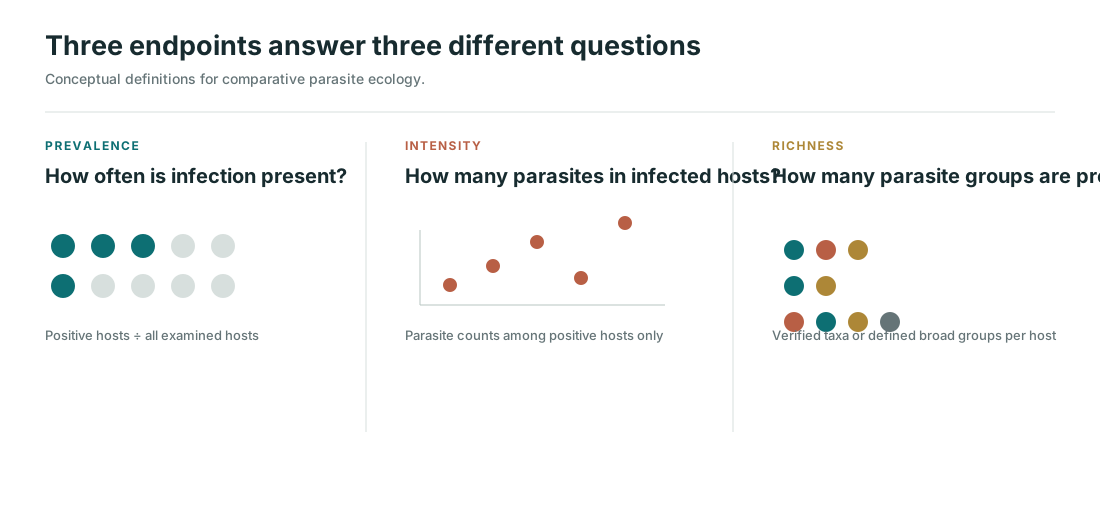
Comparative records integrate host identity, anatomical site, life stage, prevalence, intensity, richness, coinfection, morphology, voucher status, and molecular confirmation.
Core question: Which host–parasite associations represent co-introduction, spillover, native-parasite acquisition, host switching, or a plausible spillback pathway?
Analysis in development02
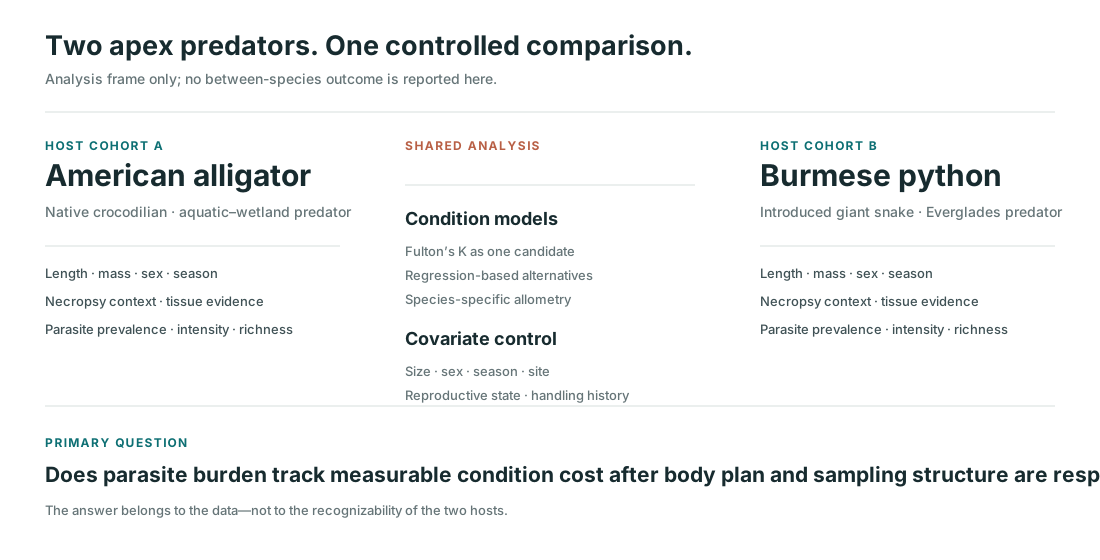
Apex predators: alligator × Burmese python
A comparative analysis of parasite burden, body condition, sex, size, season, site, and necropsy context in two iconic South Florida apex predators.
Core question: Does burden track host condition, and can any apparent difference survive species-specific allometry and seasonal confounding?
Imaging series03
Progressing pentastome morphology
Replicated early, intermediate, and mature forms are measured through calibrated whole-body outlines, hook geometry, annulation, body proportions, and fine-scale surface features.
Core question: Which morphological changes are developmental, allometric, host-associated, or taxonomically informative?
Locked test retained04
Recall-first microscope-field localization
A field-level candidate proposal system is evaluated by centroid recall, review burden, category capture, failure modes, and external challenge performance—not by inflated diagnostic language.
Core question: Can heterogeneous fields be triaged reliably enough to make expert review faster without hiding misses?
Case archive05
Early detection and rapid response
The Boa imperator Everglades case connects field detection, rapid coordination, morphology, genetics, necropsy, and ecological context as a model for incipient-invasion documentation.
Core question: What evidence and response architecture turns a rare detection into an actionable, defensible case study?
Long-term06
South Florida specimen–image atlas
A durable regional archive would link hosts, collection events, parasite specimens, images, measurements, vouchers, sequences, review status, and publications.
Core question: Can scattered records become a surveillance network without losing taxonomic or specimen-level context?